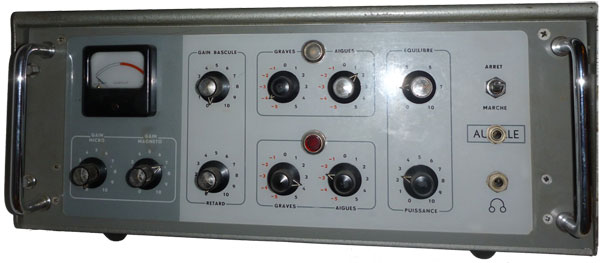
Aurelle 1965
What happens when we speak? We project sounds into the air (high-pitched sounds shoot out in a straight line, while low-pitched sounds spread everywhere and throughout our surroundings, which explains why our recorded voice always seems higher to us than in real life). But at the same time, the skull vibrates and transmits sonic information directly to the ear. Experimental verification proves that great opera singers — that is to say, good technicians — monitor themselves essentially through bone conduction. In stammerers, on the contrary, there is between the bone-conduction auditory curve and the air-conduction curve a disharmony that is always to the disadvantage of the former.
From this observation arose the idea of a treatment that would restore harmony. To this end he had to improve the Electronic Ear by adding bone listening to it, so as to be able to regulate one passband or another by pulling a little harder on the stapedius muscle or on the tensor tympani muscle. At the same time, he endeavoured to impose right-ear dominance by bringing the system of electronic switching into play.
1965 — Microphone input, Tape-recorder input, Delay, electronic switching, C1, C2, Air conduction, Balance, Bone conduction.