The Evolution of the Electronic Ear
The Electronic Ear is the central instrument of Alfred Tomatis’s approach. Designed to act upon listening, it underwent, over half a century, a series of successive improvements. This page retraces its technical evolution; each device is then presented, with its photograph, in the entries of the Museum.
From the experimental assembly to switching (1947-1950)
Emerging from the war, Alfred Tomatis examines two very different populations: workers exposed to noise in the Aeronautical arsenals, and singers in vocal difficulty. From this comparison is born, in 1947, his founding proposition — a subject vocally reproduces only what they are able to hear.
To verify it, he has his patients listen, by means of an assembly of microphone, filters, amplifier and headphones, to a reconstituted listening: with the headphones on their ears, they sing better; with the headphones removed, the effect disappears. The whole challenge then becomes to make this passing effect durable. In 1950, the observation of a singer leads Tomatis to the idea of switching — making the ear alternate between two listening conditionings.
The first Electronic Ear (1952)
The first device to incorporate switching is built in 1952; its development constitutes one of the essential stages of Tomatis’s scientific journey. It rests on two tone correctors — the channels C1 and C2 — between which the subject’s listening is switched. The switching is done by manual switches, noisy and delicate to handle: one must switch at the exact moment so as not to compromise the conditioning.
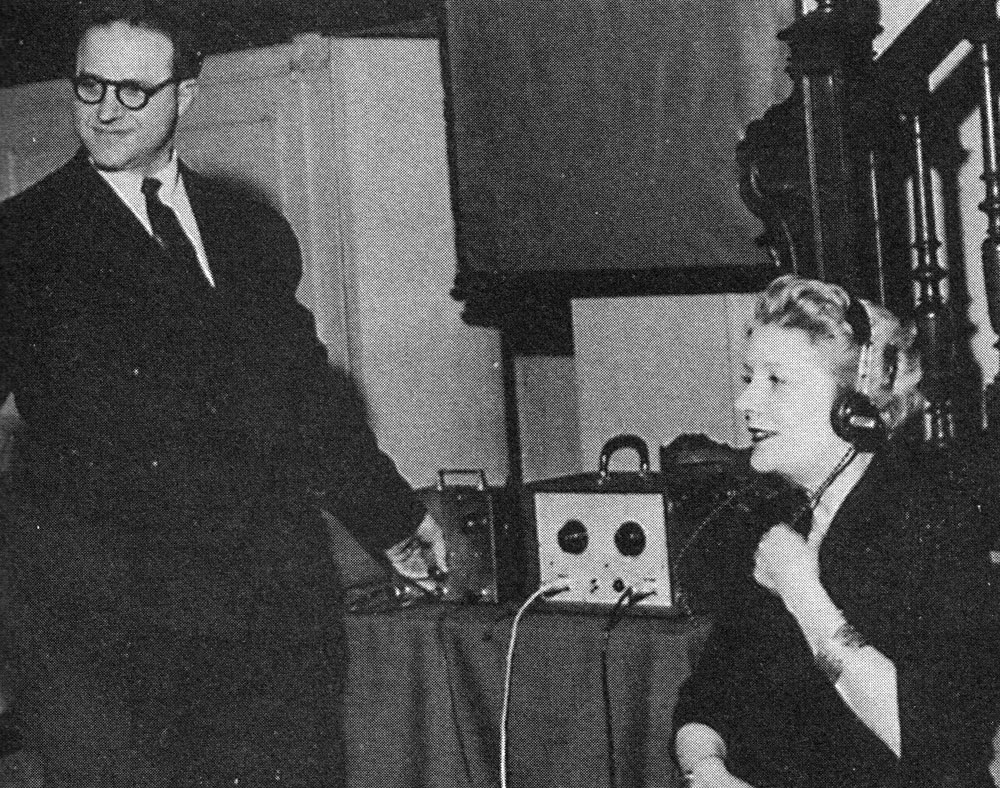
1952 — microphone input, conditionings C1 and C2, air pathway, balance.
Electronic switching (1954)
In 1954, Tomatis automates the switching by means of electronic controls. It is this device that revolutionises the apparatus and gives it its definitive name: the Electronic Ear.
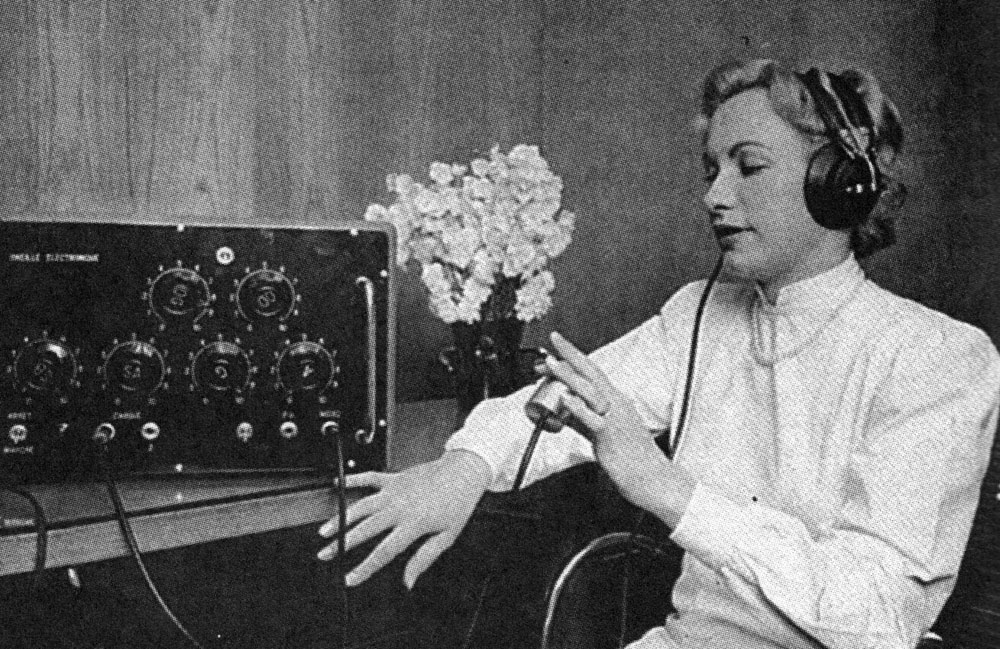
1954 — microphone input, electronic switching, C1 and C2, air pathway, balance.
Musical listening and delay (1955-1956)
In 1955, a “line” input is added: the device can henceforth play music, and no longer merely restore the patient’s voice. In 1956, following American work on delayed feedback, Tomatis introduces the delay parameter, linked to his research on stammering.
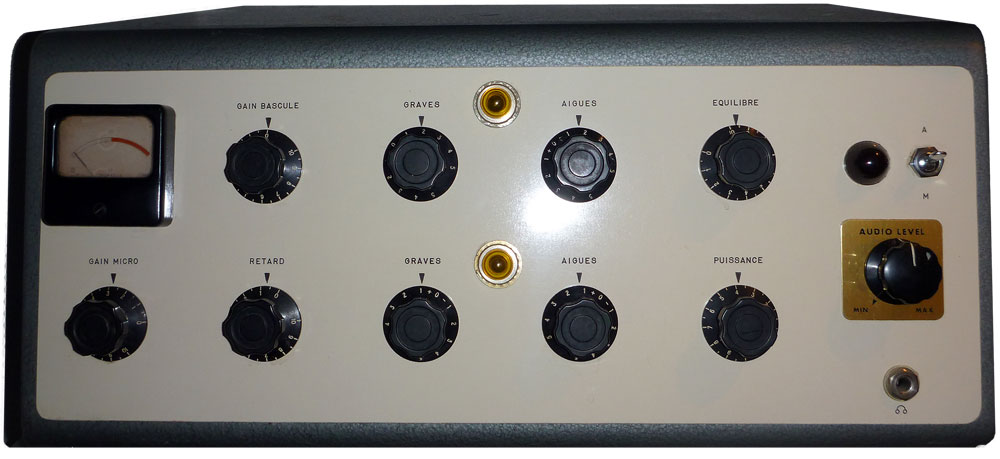
1955 — microphone input, delay, electronic switching, C1 and C2, air pathway, balance.
Bone listening (1965)
In 1965, Tomatis adds to the device listening by bone conduction, which transmits sound directly through the bones of the skull. The Electronic Ear thenceforth makes it possible to act both on the air pathway and on the bone pathway.
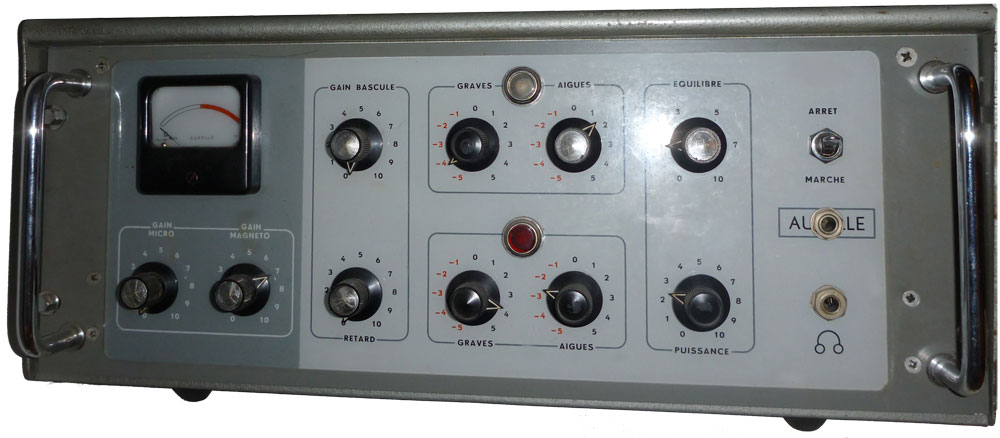
1965 — microphone input, tape-recorder input, delay, electronic switching, C1 and C2, air pathway, balance, bone pathway.
Precession (1980s)
At the beginning of the 1980s, the work carried out in Toronto with the engineer Ed Agnew moves the device from valve electronics to transistor electronics. A new parameter is introduced, “precession”, which corresponds to the anticipation of the bone pathway over the air pathway.
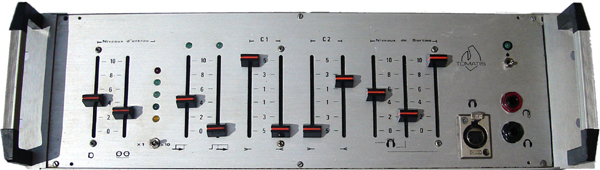
Around 1980 — the device incorporates the precession parameter.
The integrated filters (1988)
At the end of the 1980s, Alfred Tomatis’s Paris company, Tomatis électronique, produces several small series of devices. In 1988, the filters are integrated directly into the machine: the EE3PFR2 model — the most cited in the literature devoted to the method — makes it possible for the first time to carry out the whole treatment without an external accessory.
Industrialisation and the analogue line (1992-2000)
In 1992, faced with the increase in orders and problems of reliability, Alfred Tomatis entrusts the manufacture of his devices to Christophe Besson, an engineer committed to the method since 1986, who establishes in Switzerland a dedicated company. From this takeover is born the A1 model.
Digital prototypes — the A2, A3 and A10 models — are then explored, and subsequently set aside: in use, they did not reproduce the results obtained with the analogue devices. This observation lastingly fixes the line in the analogue domain. In 1995 appears the A1 NewTec, a redesigned analogue machine that integrates the whole of the EE3PFR2’s functions. At the end of the 1990s several models follow — APP Azure, APP Digital, then the NN425, NN426 and NN427 —, the last of which were still tested by Alfred Tomatis himself, up until 2000.

1992 — the A1 model, first machine of the industrialised line.
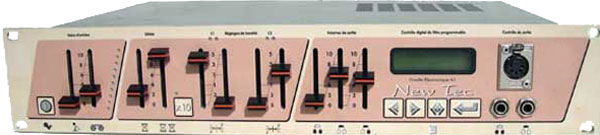
1995 — the A1 NewTec, redesigned analogue machine.
After 2001
Alfred Tomatis dies in December 2001. The manufacture of the analogue Electronic Ear continues after him, in fidelity to the principles he had established. The devices produced since then belong to contemporary activity and not to the historical heritage: the present Museum stops at the machines conceived during Alfred Tomatis’s lifetime or directly issuing from his work.
This page retraces, in a factual register, the technical history of the device. The first-hand account of this adventure, by Christophe Besson — who ensured its manufacture from 1992 onwards —, will be presented in the Testimonials section.